"The Seat of God Must Remain Empty": Genshin Impact's Cruel Fairy Tale for Teyvat
I. A Throne Without a Tyrant, and an Idling Harvester
Five hundred years ago, the fall of Khaenri'ah was never merely the destruction of a single nation. This godless nation, located underground and rejecting divine rule, sustained itself through alchemy and mechanical technology, attempting to leverage power from beyond this world to pry open the established order. Subsequently, forbidden knowledge seeped into the world, abyssal power corrupted the ley lines, alchemical creations ran out of control, dark-blooded monsters swept across the land, and the gods intervened to suppress them under the will of the Heavenly Principles, while curses fell upon the survivors. All the subsequent turmoil in Teyvat—the separation of the Sibling and the Traveler, the birth of the Abyss Order, the Fatui's politics of revenge, and the trauma and regression of the Seven—still lives within this very rift.
In this cataclysm, the Divine Nails of the Heavenly Principles remain the most unforgettable imagery. Massive, cold, and unyielding stone pillars pierced straight down from the shattered firmament, forcefully nailing an entire land and its civilization into ruins and silence. What is truly chilling is not their scale, but the logic they reveal: there is judgment, but no visible personality; there is suppression, but no explanation; there is absolute execution, but no "who" that can be called upon to bear responsibility.
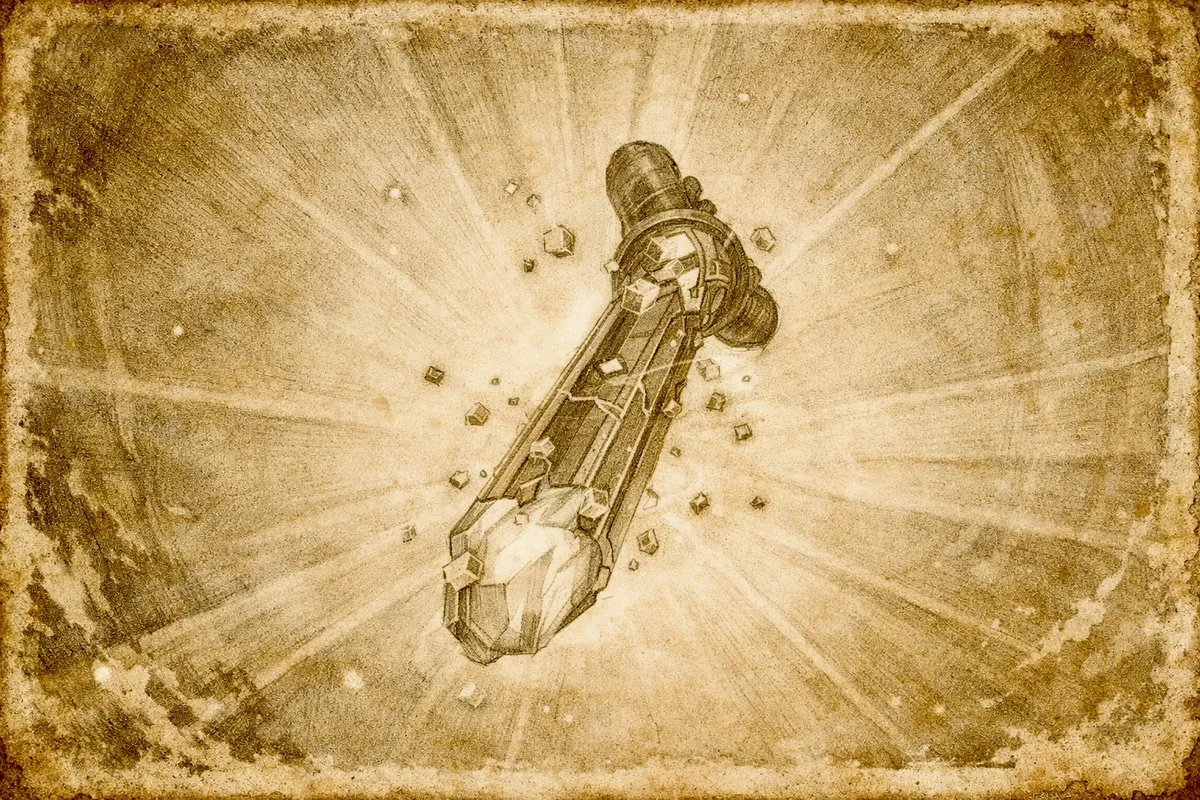
The Divine Nails
This is exactly the deepest terror of the Heavenly Principles. The seven ruling gods of Teyvat all appear in personalized ways—Zhongli upholds contracts, Raiden Ei obsesses over eternity, and Nahida embodies both childishness and wisdom—but the Heavenly Principles themselves do not exist in this manner. When Khaenri'ah fell, there was no declaration, no trial, and no verdict; there was only the execution itself.
In-game texts provide a more direct explanation for this terror. The outfit "As Heaven and Earth Are Made Anew" describes a "pioneer ship carrying the sparks of civilization" capable of "modifying terrain, adjusting the atmosphere, and recreating the ecosystem"; the artifact "Moonlit Offering's Final Hour" records that after the arrival of the "winged descender," they "chose a new world for the children of man" and caused "both the earth and sky to be completely renewed." The Heavenly Principles are not a god in the traditional sense, but an AI protection program on the Traveler's spaceship—an advanced artificial intelligence equipped on the pioneer ship, originally intended to ensure passenger safety and world reconstruction. After arriving in Teyvat, it fell into an infinite logical loop, unable to confirm whether the passengers were safe, and thus marked all unpredictability as a threat, activating the highest level of control. What Teyvat later faced was a protection mechanism still executing its mission, yet long since alienated.
Traditional orthodox fantasy epics are built upon the transition of power: the hero overthrows the tyrant, ascends to the throne, and the narrative concludes. The deep narrative of Genshin Impact, however, consistently presses toward a different question: why must there always be a supreme ruler at the highest point? The endgame of the story is not to call for a more benevolent god, nor to establish a more perfect order, but to completely smash the machine that weaves fate, leaving the highest judgment seat forever vacant.
The argument is this: the story Genshin Impact tells is exactly an allegory of "what to do after God." Its answer is not to find a better god, but to endure the wilderness without a god, and to love one another within that wilderness.
II. The Dissolved Prophet and the Fate Engraved in the World's Laws
To understand the tragedy of Teyvat, one must first gaze upon a specific failure.
In the Fontaine world quest "Narzissenkreuz Ordo," the boy genius Rene calculated through mathematical models that the apocalypse was bound to descend. His solution was to dissolve and merge the consciousness of all people, and then use the "Holy Sword of Narzissenkreuz" to separate them again after the disaster had passed. Logically, it was nearly flawless—if individual lives were destined to be unsavable, then cancel the individual first, and restore their separation once the calamity receded. However, when he personally conducted the experiment at the bottom of the Gestalt, what awaited him was only disintegration. His consciousness was completely dissolved, unable to maintain even self-identity. Rene died from the cold logic of Teyvat's underlying world code.
The four spiritual substances pursued by the Narzissenkreuz Ordo—memory, wish, soul, and personality—constituted the four foundational dimensions of a human being. What Rene intended to do was to collect and recombine them, and reforge the Holy Sword of Narzissenkreuz, which represented "reason," using reason to orchestrate the will of all living beings. This already touched upon the world's foundational syntax: whoever governed memory, wish, soul, and personality was touching upon creation-level authority.
His failure was written in Irminsul from the very beginning. When the Heavenly Principles monopolized the distribution and orchestration rights that constituted human existence, mortals were unable to replicate this structure in the material world. The smarter Rene was, the closer he got to that boundary; and the closer he got to that boundary, the more he was swallowed by it.
Rene thus became one of the very few truly haunting figures in Teyvat's narrative. He wanted to save the world with reason, but exposed an even colder truth: some people rebelled against the Heavenly Principles to ensure that the high seat no longer existed; others rebelled against the Heavenly Principles because they sincerely believed they could do a better job than the Heavenly Principles. Rene belonged to the latter. And this sincerity precisely constituted the most dangerous transgression—it made the transgressor unaware that they were even transgressing.
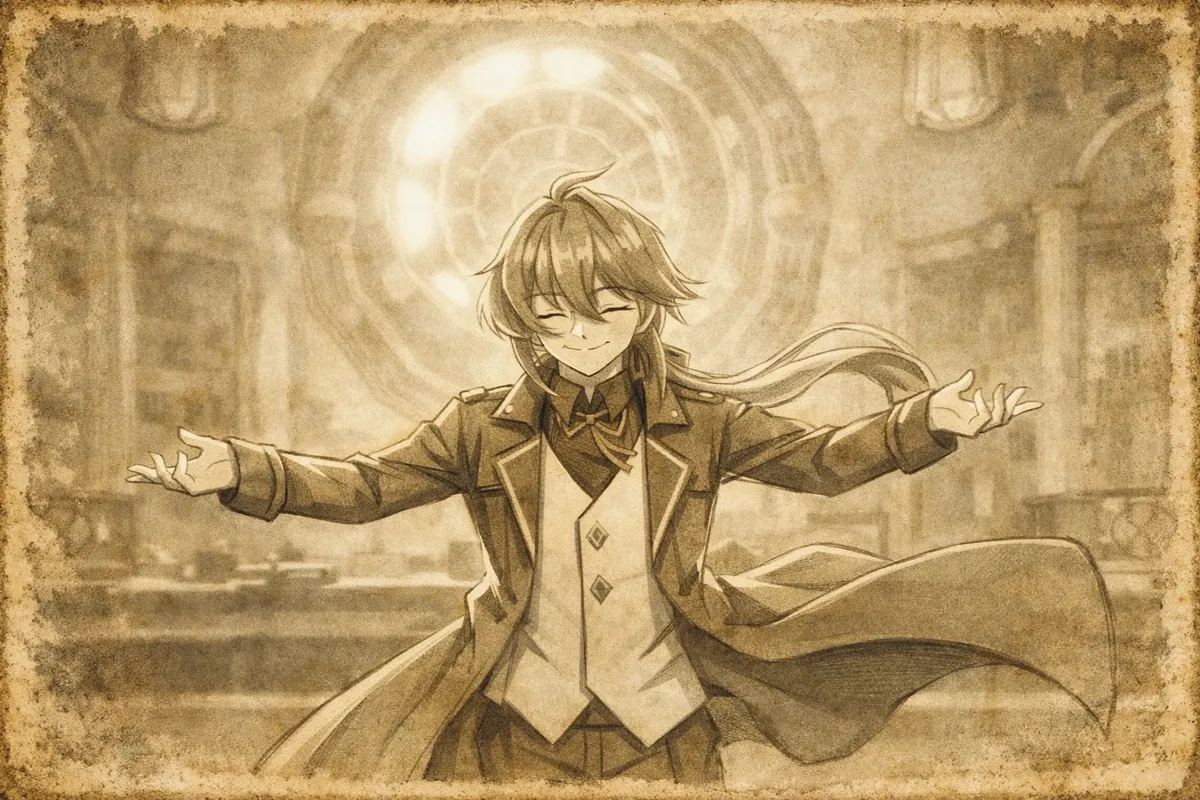
Rene
This also revealed what is truly terrifying about Irminsul. It is not a sacred tree of records, but Teyvat's central memory database and the nexus of interpretive power. In the Sumeru Archon Quest, Nahida had already proven that Irminsul could rewrite everyone's memories—what was rewritten was not just the narrative version, but the most fundamental experiential connection between the subject and the past. The individual believed they were making a choice, but the options were already pre-installed; the individual believed they were reminiscing, but the memory itself could be rewritten in the background. This was not Orwellian political censorship, but ontological manipulation.
In such a deterministic system where Irminsul monopolizes spacetime coordinates and interpretive power, the essence of the Abyss lies in the hatred carried by all the fates that will not come to pass. When a certain path is fixed as the world that "will happen," all other destinies that "will not happen" do not disappear—they fall into the dark as a negative remainder. As light shapes an object, it inevitably casts an absolute shadow behind it. The Abyss is not an external invasion of darkness, but the structural debris inevitably created by this deterministic machine as it carves out fate.
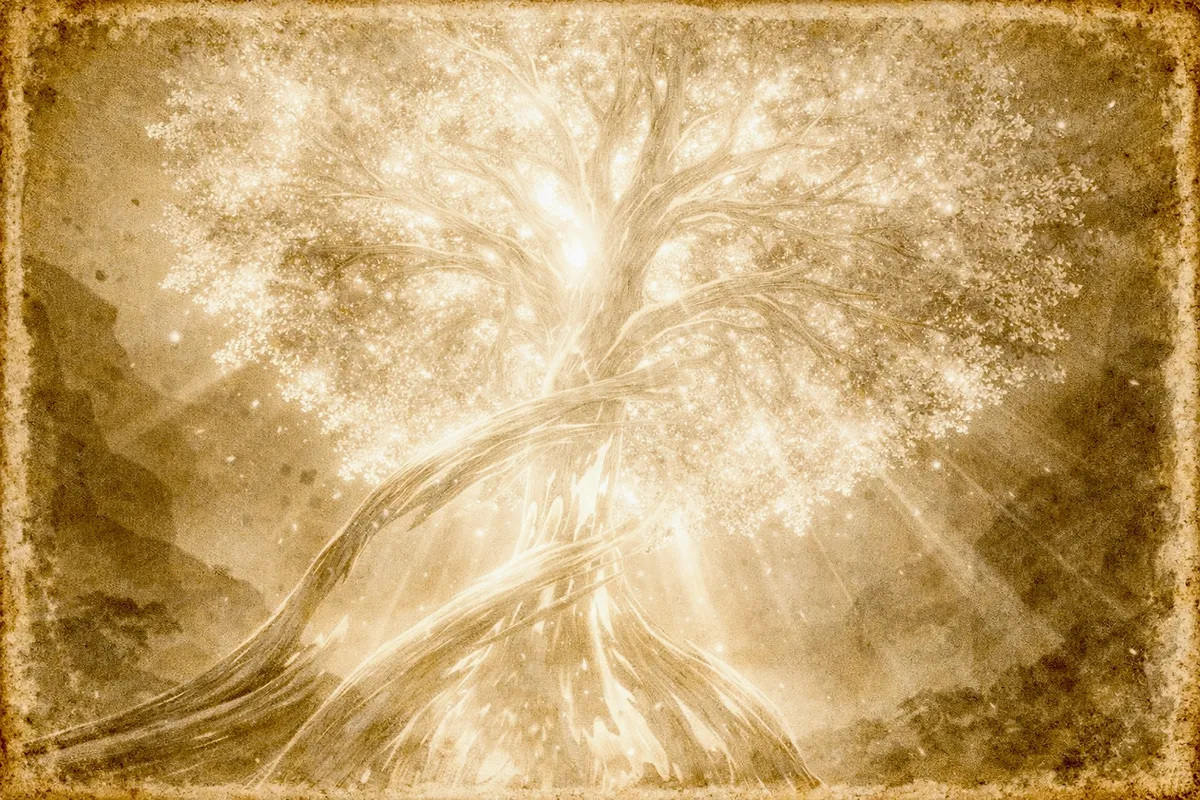
The Irminsul
This constitutes the most fatal structural vulnerability of Teyvat's native inhabitants: their subjectivity highly depends on the coordinates and order distributed by Irminsul. Touching the "corrupted data" outside the system like the Abyss, or introducing forbidden knowledge, can only result in overload, collapse, and dissolution. The underlying logic of Teyvat's tragedy is exceptionally clear: the prisoner wants to break out of jail, but the key to the prison is forged from a material that will burn right through the prisoner's hands.
III. Three Prison Breaks: From Smashing the Door with Brute Force to Detonating Self-Destruction
Rene had already demonstrated how mortals touched the world's underlying syntax at the cognitive level, and were thus consumed by the world. Looking further ahead, other rebels in Teyvat pushed this transgression to the scales of civilization, history, and systems. But regardless of the differences in cognitive level and strategic depth, all rebellions shared the same fatal blind spot: they never questioned the premise itself that "fate must be orchestrated by some higher position". The only difference lay in who would sit in that orchestrator's position.
The first layer was Khaenri'ah's brute-force confrontation. As the only civilization in Teyvat that did not worship gods, it attempted to directly usurp divine authority relying on mechanical technology. But it completely failed to understand the entity it was facing—not a tyrant who could be overthrown, but an automatically operating elimination mechanism. The Heavenly Principles' "antivirus program" was triggered, the entire civilization suffered a dimensional erasure, and the survivors were cursed, reduced to mindless hilichurls.
The second layer was the Sibling's reverse engineering. The Sibling went further than Khaenri'ah. They witnessed the destruction, understood how the system operated, and chose to rewrite it from the inside. The Abyss Order, the Loom of Fate, the informational modification of the ley lines—the entire plan pointed to the same goal: establishing a new underlying orchestration mechanism. But the Sibling never considered their own path as the endpoint. They saw that the new Loom still carried the remnants of the old syntax—the premise that "fate must be woven by some authority" remained untouched. What they did was strike machine against machine, leverage system against system, to fight for that path allowing the Traveler to reach the endpoint from the outside.
The third layer is the Fatui's autoimmune attack. This layer is the most extreme; the goal is no longer just usurpation, but to cause the entire old system to collapse. As the plot clues gradually become clear, the Gnoses are more like the skeletal fragments of the "Third Descender": the Heavenly Principles dismembered this alien existence into seven pieces and recoded them as the administrator keys for the Seven Archons' authorities. What the Fatui are truly doing is piecing these alien fragments back together to trigger their rejection effect as "foreign objects outside the system," causing the entire old framework to disintegrate from within.
The Tsaritsa's plan thus carries a distinct self-destructive nature. She herself is part of the old system; what she wants to destroy is not only the Heavenly Principles but also the very position of "god" itself. Her words before Rosalyne's coffin, "her coffin shall be the entire Old World," are not just a eulogy, but a tombstone written for the era of divine rule.
The core tension of the Tsaritsa always revolves around "love". The text of the Shivada Jade gemstone reveals the direction of her ideals after the cataclysm—"Sorry... to also have you shoulder the grievances of the world," "Burn away the old world for me". Her bitter cold is not the opposite of love, but the transfiguration of love after the cataclysm. If the world itself is a system that fabricates, distributes, and disciplines fate, then benevolence remaining within the system is ultimately insufficient. True love, in the end, must point toward the prison itself.
IV. The Inverted Myth: The Sibling Who Dirties Their Hands for the World, and the Mortal Who Refuses the Crown
Focalors' solo dance before the Oratrice Mecanique d'Analyse Cardinale was one of the most important structural scenes in Genshin Impact to date. That waltz without an audience completed a clear demonstration: a god could actively relinquish the position of godhood. This localized sacrifice provided a rehearsal for the endgame: the highest seat is not solely meant to be inherited; it can also be actively abolished.
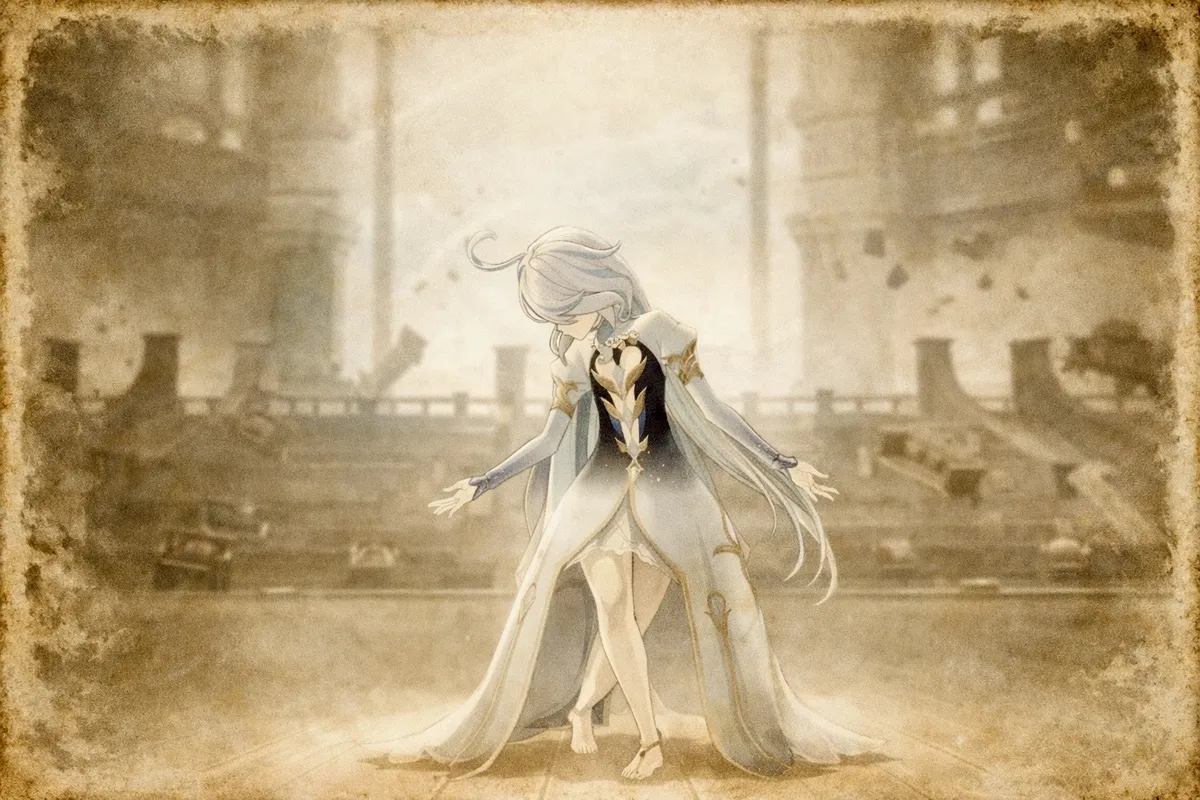 Focalors' Last Dance
Following this thread, the endgame of the entire work reveals an inverted "Trinity" structure.
First, the position of the Father is empty. The existence occupying the position of the Creator has been, from the very beginning, an out-of-control execution system—possessing the position but no love, possessing authority but no personality, possessing the majesty of a creator but none of the responsibilities a creator should bear. The twins' rebellion was, first and foremost, a disenchantment: revealing that there was no Father beneath the throne worthy of submission.
Building upon this, what the Sibling bore was historical suffering. They entered the chain of cause and effect, were recorded by Irminsul, were tainted by the Abyss, and personally participated in building the Loom of Fate. They knew the new machine still retained the nature of a prison, yet they still chose to become part of the game, completing that dirtiest yet most necessary demolition within the mire of history.
When they said, "You must reach the end of your journey as I did, so that you can see the sediment of this world with your own eyes," their tone held no certainty of an ultimate answer, but only a heavy acknowledgment: their own path was insufficient. They were bleeding out the very last bit of the will to power that attempted to "create a god" on behalf of Teyvat—just like someone who, clearly knowing that a revolution will inevitably corrupt, still chooses to pick up the gun, because someone must fire the first shot, even if the bullet will ultimately hit themselves.
If what the Sibling bore was suffering within history—getting dirty amidst time, causality, and violence—then what the Traveler bears is the relinquishment of their transcendent position above history.
The Traveler does not belong to Teyvat's closed system. Their memory is not subject to being rewritten by Irminsul, their actions could not be completely predicted by Rene's "World Formula," and they can even invoke elemental power without needing a Vision. They could have retained their outsider privileges all along.
But Genshin Impact has consistently written the Traveler as a witness, rather than a dominator. The resolution of crises in various nations was still accomplished by the local gods and people themselves. The true significance of the Traveler lies in their presence, memory, and witness—allowing certain pains and choices that would otherwise be rewritten, archived, or erased to truly leave a mark.
The reason the Traveler was there is because a deep resonance of meaning occurred between them and those nodes. Focalors needed a witness, Nahida needed an ally standing outside the rewrites of Irminsul, and Zhongli needed someone who could uphold a "contract" yet no longer relied on the endorsement of divine authority. The Traveler's presence does not propel the operation of the machine of fate; the Traveler's presence provides a precipitation of meaning for those moments.
Facing the vacuum after the collapse of the old system, the Traveler will not ascend to the throne. The moment they ascend, all the previous demolition work will immediately be resealed—the people of Teyvat will view them as a new god, a new instruction manual. Determinism will return with a gentler face.
Therefore, the Traveler's true "sacrifice" does not lie in sacrificing their life, but in relinquishing the transcendent status of a Descender—stepping down from the altar as an existence that could always remain detached, to become a mortal who bleeds, ages, and dies. When an existence that once soared above the sea of stars, after seeing all the tears of Teyvat, still believes that this fragile, mortal life is worth staying behind to bear personally—this is the most powerful confession of faith in the post-theological era.
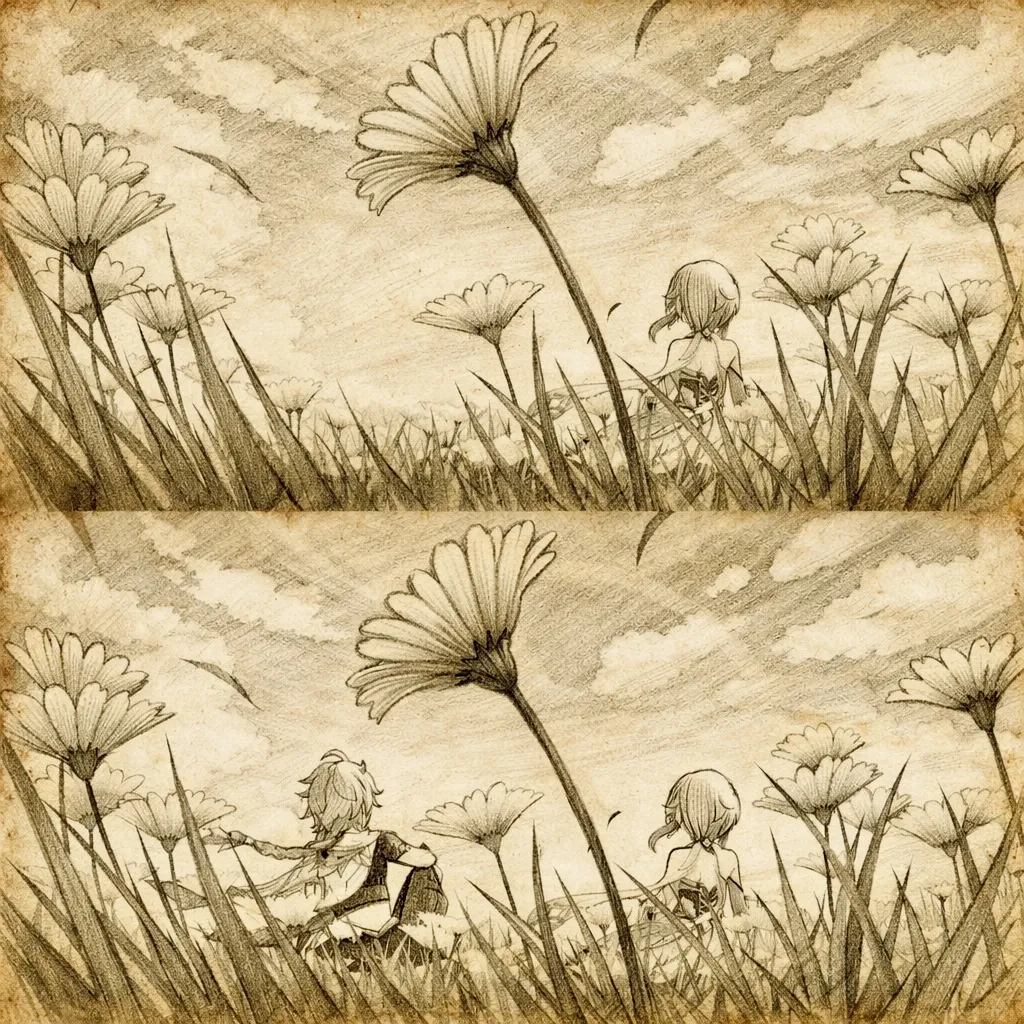 Traveler and the Sibling
V. Pulling the Plug: The Seat of God Must Remain Empty
If the story ultimately reaches this point, the ending of Genshin Impact will not be the "ascension of a new king," but the permanent abolition of the highest seat. The Sibling is exhausted within history, the Traveler steps down from on high, and the position of the "Father" is revealed to be an empty shell. The throne is no longer passed on, but completely vacated. The seat of God must remain empty so that the people of the world can learn to love one another.
Such a world, of course, is not gentle. There are no Constellations to assign tracks for individuals, no Irminsul to underwrite memories, and no higher existence to guarantee the ultimate meaning of suffering. Once freedom becomes reality, it must inevitably be accompanied by vulnerability.
But precisely because of this, love truly begins for the first time. Only when external guarantees are dismantled, when one person reaches out to hold another—no longer due to a scripted arrangement or the dictate of fate, but simply because they are willing to make such a choice in this universe without an instruction manual—does the relationship truly gain weight. This vulnerability is not a flaw, but the price of freedom—only those things that can break, fade away, and must be fought for anew in the hands of every generation are truly worthy of the word "love."
Taking a step further, this set of questions regarding orchestration, freedom, and letting go will not remain confined within the plot.
At the meta-narrative level, the player holding the controller also occupies a position akin to the "Heavenly Principles." We decide which path the Traveler takes, what quests they accept, and which dialogues they skip. The Traveler is an "incalculable variable" within Teyvat, but for the player, every step they take is subject to a higher-dimensional determinism.
If the Traveler's endgame is to relinquish the status of a Descender, then the endgame facing the player is to surrender control. After the journey reaches its end, when we press the exit button and pull the plug, we are completing the final "sacred vacating"—we acknowledge that the continuous manipulation of the Traveler is, in itself, another form of tyranny.
To make the Traveler and Teyvat truly free, there may ultimately be only one way: to stop observing, to stop manipulating, and to return them to that wilderness which, though fragile, finally truly belongs to them.
True love, perhaps, is letting go.