Borrowed Regulation
Care, Repair, and the First Formation of the Container
Prelude
There are moments in early care that look trivial from the outside and are not trivial at all. A baby cannot settle. A toddler collapses into rage because the wrong cup was placed on the table. A school-aged child returns from the world overstimulated, brittle, and no longer able to carry what the day has placed inside them. In such moments, the adult does not merely comfort. The adult lends structure. They take into themselves, for a time, what the child cannot yet organize alone: pace, rhythm, proportion, sequence, return. What appears on the surface as soothing is often something more fundamental. It is borrowed regulation. The neurobiological dimension of this process has been extensively described in the developmental neuroscience literature on interactive affect regulation (Schore 1994; 2012). And it may be one of the earliest forms in which a human being learns not simply to feel better, but not to collapse before reality.
The language of parenting often begins too late. It begins with guidance, discipline, values, resilience, communication. But before any of these can take root, something more basic must already be underway. A child must first be helped to become the kind of being for whom reality can be borne, interruption can be survived, and another person can become perceptually real without immediate defensive closure. The question of this essay is therefore how care builds the first container from which moral life later becomes possible (Vale 2026, chap. 1).
I. Care as the Earliest Scene of Formation
Chapters 1 through 3 of this sequence asked what moral perception is, what crisis reveals about its thresholds, and how the self becomes capable of such perception through relational sediment (Vale 2026, chap. 1–3). This essay moves further back. It turns to the earliest scene in which such a self is formed at all: care. Before moral perception can be exercised, before relational history can sediment into a stable capacity, one nervous system must first lend organization to another. Borrowed regulation names that event. It is not yet morality, but it may be one of morality's earliest conditions.
II. Witnessing Before Guidance
A child of three or four is building with blocks. The structure keeps failing. Each attempt collapses into the next. Frustration accumulates beyond what the child can yet organize alone. At last, the child turns and strikes the arm of the adult sitting nearby.
One adult responds by striking the child back. The explanation is immediate: I hit you so that you know pain, and then you will stop hitting me.
Another adult responds differently. A hand is placed on the child's warm, agitated back. The adult invites the child to close their eyes and breathe together. The blocks are not discussed. The hitting is not yet discussed. For a moment, the task itself is allowed to disappear, until the child can return to a state in which the body is once again inhabitable.
The difference between these two responses is not, in the first instance, a difference in discipline philosophy. It is a difference in what each adult perceived the child's action to be.
The sentence spoken by the first adult is unusually revealing. Its aim is not that the child learn to regulate frustration. It is not even that the child learn that hitting is wrong. Its aim is simpler and more telling: that the adult no longer be struck. The child's act has already been processed as a problem for the adult rather than as a state the child is undergoing. Before punishment occurs, misrecognition has already taken place.
What the child expressed in that moment was overflow. The repeated failure of the task had exceeded the child's available capacity for self-organization and spilled outward in physical form. The first adult reads overflow as attack and answers it as attack. The second reads overflow as overflow and answers it with structure.
What this scene makes visible is that misrecognition is rarely a simple failure of information. The first adult is not ignorant of what has occurred; the adult has seen the blow. What is missing is a more accurate reading of the state from which it emerged. That absence is quickly filled by projection. The child's overflow is interpreted through the adult's own experience of being struck: annoyance, injury, disrespect, challenge. The child's act is no longer received as the bodily expression of a disorganized inner state, but as an intentional imposition upon the adult. The child's reality is displaced by the adult's felt impact. Projection does not enter after perception as a secondary distortion. It enters at the level of perception itself, organizing what the act is taken to be.
What this mechanism reveals is that witnessing the child as a being is not a supplement to accurate perception. It is its precondition. A child treated primarily as a problem to be managed, a behavior to be corrected, or a disturbance to be neutralized cannot be accurately witnessed. The child becomes legible only as an effect on the adult. But care begins elsewhere. It begins when the child's action is read not only in terms of what it does to the caregiver, but in terms of what it reveals about the child's present capacity to bear reality. To encounter the child as a being is to keep the child's present state—rather than its effect on the adult—as the first object of attention, even when that state expresses itself as disruption. This does not dissolve all boundaries. It reorders what comes first.
Only from such an ordering of attention can guidance become more than escalation. If the child's present state is not first registered with some accuracy, then any subsequent limit, correction, or consequence is likely to land not as form but as added force. The question is not whether the hitting must eventually be addressed. It must. The question is whether the child is first brought back to a state from which anything in the interaction can be received without further disorganization. This is the point at which witnessing becomes more than perception. It becomes the condition of return. For what the child needs in such moments is not only to be correctly read, but to be brought back from overflow into a form of contact that can survive strain. That movement—from misattunement or rupture toward restored relation—is the work of repair.
III. Repair as the Architecture of Durability
Witnessing, then, is not yet repair. It is the perceptual condition without which repair cannot begin—the prior act of reading that determines whether what follows will land as form or merely as force. But accurate perception of the child's state does not by itself restore contact. Something further is required: not only to see what has happened, but to return after it. That return, and what it builds over time, is the work of repair.
Repair begins from a fact that developmental and moral life share: rupture is inevitable. No caregiver can remain perfectly attuned, no child permanently organized, no relationship untouched by misreading, frustration, fatigue, or conflict. The question, then, is not how rupture can be prevented altogether. It is what kind of world the child learns to inhabit once rupture has occurred. A world in which disorganization is met by retaliation, withdrawal, or cold control teaches that strain ends contact. A world in which contact can be re-established—without denial, without theatrical remorse, without abandoning boundary—teaches something else: that reality can hurt without becoming annihilating, that error need not become expulsion, and that relationship can survive interruption. Repair, in this sense, is one of the primary ways durability is built.
More strongly: repair is one of the central mechanisms by which the container forms at all. A child does not become durable by inhabiting a world in which nothing ever goes wrong. Such a world does not exist, and even if it did, it would leave the child unprepared for reality. Durability is built when misattunement does not become catastrophe, when disruption is followed by reorganization, and when the child repeatedly discovers that loss of contact need not mean loss of world. What sediments in such moments goes deeper than trust in a particular adult. It becomes a general structural expectation: that disorganization can be survived, that relation can be restored, that strain need not end in collapse.
Over time, this is how a relationship that can come back becomes a self that can come back. The child first lives return externally, in the caregiver's capacity to re-enter after error, to restore rhythm after rupture, to remain present without either engulfing or abandoning. But repeated often enough, that external pattern ceases to be merely interpersonal. It becomes intrapsychic form. What the child borrows from the caregiver's capacity to return is, over time, made internal. The child begins to acquire something of the same capacity: not never to fragment, never to rage, never to despair, but to find again an internal path back from those states. In this sense, repair teaches the nervous system—and eventually the moral self—that interruption is not the end of continuity.
The deepest gift of repair is not reassurance. It is returnability.
Repair, however, is never only a principle. It takes form in acts. A caregiver lowers the voice instead of raising it, re-enters the room after anger, names what happened without theatrics, restores sequence after chaos, places a hand on a child's back and lends a rhythm the child cannot yet produce alone. Sometimes repair begins not with explanation but with reduction of pressure: the task is set aside, the overstimulating object disappears for a moment, the body is brought back toward inhabitable limits before words are asked to carry meaning. Only then can any boundary, apology, or correction land as form rather than as further pressure. This is why repair cannot be separated from judgment about dosage. To bring a child back is not simply to return emotionally; it is to sense when reality has exceeded what can presently be borne, and to help restore an interval in which contact becomes possible again. At that point, repair opens into a further task: not only returning after rupture, but discerning what kinds of difficulty build structure and what kinds dissolve it. That question belongs to thresholds.
IV. Thresholds: Bearable Difficulty and Corrosive Pain
If repair teaches that rupture need not become annihilation, threshold calibration asks a more difficult question: what kind of pain can help build a self, and what kind begins to dissolve it? Parenting fails here in two opposite directions. One removes every obstacle and leaves the child structurally untested. The other imposes, permits, or misreads pain the child cannot yet metabolize, and then mistakes the resulting hardening or collapse for growth. The ethical task is neither the elimination of difficulty nor the glorification of it. It is discrimination. Some forms of pain are structuring: waiting, frustration, boredom, effort, disappointment, the repeated discovery that the world does not yield immediately to desire. Other forms are corrosive: humiliation, chaotic unpredictability, abandonment, shame without repair, fear borne without accompaniment. The difference is not merely a matter of intensity. It is whether difficulty arrives inside a relational field capable of holding it—or whether it arrives alone.
This is why the caregiver's task is not to spare the child all pain, but to judge dosage. A child struggling with the collapsing blocks does not need the frustration erased; the frustration is part of what reality is. But neither can that frustration simply be left to accumulate past the point at which it remains metabolizable. The question is not whether the child should suffer, but in what form, in whose company, and to what extent. Difficulty becomes formative when it is bounded, accompanied, and returned from. It becomes corrosive when it exceeds available structure and leaves the child alone inside an experience that can no longer be borne except through shutdown, attack, or fragmentation. Threshold calibration is therefore one of the most exacting forms of care. It asks the adult to sense not only what is happening, but how much of it this child, in this state, at this moment, can survive without disorganization becoming the lesson.
What determines whether pain becomes structuring or corrosive is not the pain itself, but the conditions in which it is borne. Pain accompanied—held within a relational field, bounded by someone willing to remain present—can be returned from. Pain that isolates, that leaves the child alone inside what exceeds available structure, cannot. In this sense, repair is not something added to difficulty after the fact. It is what makes the difference between difficulty that builds and difficulty that dissolves: the presence of a return that the child does not yet have to make alone.
What distinguishes growth from trauma is not the mere presence of pain, but the structure in which pain is borne. Growth pain stretches the child without dissolving the child. It may frustrate, delay, humble, or disappoint, but it does so within limits that preserve continuity of self and relation. Traumatic pain has a different structure. It exceeds available form, isolates the child within what cannot yet be carried, and leaves no usable interval between impact and disorganization. Accompaniment is not the removal of difficulty, nor the sentimental softening of reality. It is the presence that keeps difficulty from tipping into what can no longer be held. The adult does not erase the world's resistance. The adult helps ensure that resistance arrives in a dose that can still be lived through, rather than only defended against.
For this reason, the injunction to "let the child toughen up" is often far less clear than it appears. Sometimes it names a necessary refusal to overprotect. Just as often, it conceals a failure of threshold judgment. A child left alone inside what exceeds available structure does not thereby become stronger. More often, the child becomes defended, shut down, compliant in appearance, or prematurely self-protective. None of these should be confused with durability. What builds durability is not exposure by itself, but exposure that remains bearable because someone is helping to hold its weight. The adult's steadiness is itself on loan—present in the interaction before the child can generate it from within. The caregiver's task is therefore not to stand between the child and reality, nor to cast the child back into reality unaided, but to remain with the child long enough that what is difficult can be borne without becoming structurally deforming. Accompaniment is not rescue from the world. It is co-bearing until the world becomes livable again.
Yet this work of calibration depends on more than attentiveness to the child. It also depends on what the adult can bear. To judge dosage well, a caregiver must be able to feel distress without being overtaken by it, to remain near another's frustration without either rushing to eliminate it or retaliating against it, and to distinguish the child's present limit from the adult's own unprocessed interior. Where that distinction fails, threshold judgment fails with it. The child's difficulty is then no longer read on its own terms, but through whatever in the adult has remained unprocessed: fear that cannot tolerate distress, shame that turns overflow into offense, grief that rushes to erase all pain, anger that experiences dependency as demand. The question of thresholds therefore leads directly to a deeper one. The child is not formed only by what the caregiver does in moments of strain, but by the shape of the inner world from which those responses arise. At that point, care can no longer be analyzed only at the level of technique. It must also be understood at the level of the adult's own integration.
V. The Parent's Unmetabolized Life
The child is formed not only by what the caregiver does, but by what the caregiver is unable to do with what arises inside. A parent may know the language of boundaries, repair, and emotional attunement, and yet repeatedly fail at the moment of contact because something in the child's state activates what the adult has never been able to locate in themselves. At that point, the child no longer meets a caregiver simply responding to the present scene. The child meets an interior already shaped by older fear, older shame, older grief, older anger. What is then transmitted is not merely a reaction. It is a world. The parent's unmetabolized life enters the relation not as explicit doctrine, but as atmosphere—and atmosphere, as will become clear, is one of the earliest media of formation. The child is formed within it long before either party has words for it. To ask how the container forms is therefore to ask not only about what the adult does, but about what the adult is—and what the adult has not yet been able to become.
This does not mean that only the inwardly completed should be entrusted with care. Such a standard would make care impossible. The point is not prior purification. It is responsibility. To care for a child is to stand in a position where one's unexamined interior is no longer private in its effects. What has not been faced will still enter the relation, but now it enters asymmetrically, through a being less able to distinguish its own reality from the atmosphere in which that reality is received. In that sense, self-integration is an ethical obligation internal to care itself: the obligation to keep becoming more answerable for what one brings into the field in which another person is being formed.
What has not been metabolized in the adult does not usually reach the child as explicit content. It arrives as climate. Ungrieved loss becomes atmosphere: a heaviness without object, a fragility around certain topics, an unnamed sorrow that organizes the room before anyone speaks. Anxiety becomes law: not because rules are announced, but because haste, vigilance, overcorrection, and preemption quietly teach the child that uncertainty is intolerable and must be managed before it is even felt. Shame becomes disproportion: the child's error is not answered in its own measure, but through a reaction swollen by meanings the child did not create. What the adult has not been able to bear does not pass on as content. It is built into the ordinary conditions of contact—received by the child not as doctrine, but as the shape of reality itself.
The child receives these conditions as world rather than as "the parent's problem" for a simple developmental reason: the child does not yet stand outside the field in which they are being formed. What an adult can retrospectively identify as grief, anxiety, rigidity, or disproportion appears first to the child not as interpretation but as environment. It is not encountered as one possible arrangement among others, but as the only available texture of the real. Atmosphere is prior to explanation. It precedes doctrine, argument, and explicit value. A child does not first infer that uncertainty is dangerous; the child lives in a tempo in which uncertainty is already met with haste. A child does not first conclude that certain feelings are intolerable; the child discovers, through repeated contact, that those feelings alter the room, the face, the voice, the availability of the adult. Atmosphere is one of the earliest media of container formation. Before the child can organize experience conceptually, the child is already being organized by the climates through which experience arrives.
What the child learns first, then, is often not value in any explicit sense, but volatility. More precisely, the child learns which states can be brought into relation without endangering it, and which states seem to threaten the adult's coherence and must therefore be suppressed, hidden, softened, or converted into more acceptable forms. Anger may have to become compliance. Need may have to become charm. Fear may have to become silence. Grief may have to become competence. These are not yet moral decisions. They are early structural accommodations to the atmosphere in which the child is trying to preserve contact. In this way, the child's first education is often not in what is good, but in what is bearable to the environment. A self formed under such conditions learns, at a level far below behavior, which parts of its own reality can safely remain real in the presence of another.
Seen from this angle, parenting cannot be understood primarily as the transmission of values or the management of behavior. The child is learning what kind of reality can be borne in relation, what kind of feeling must be transformed to preserve contact, and what sort of inner life the surrounding world knows how to receive. A parent does not simply instruct a child about the world. A parent becomes, in countless ordinary moments, one of the ways the world arrives. At that point, the question of care can no longer remain a question of method alone. It becomes the larger question toward which this essay has been moving all along: what, in the most ordinary acts of parenting, is actually being built?
VI. Parenting as Container-Building
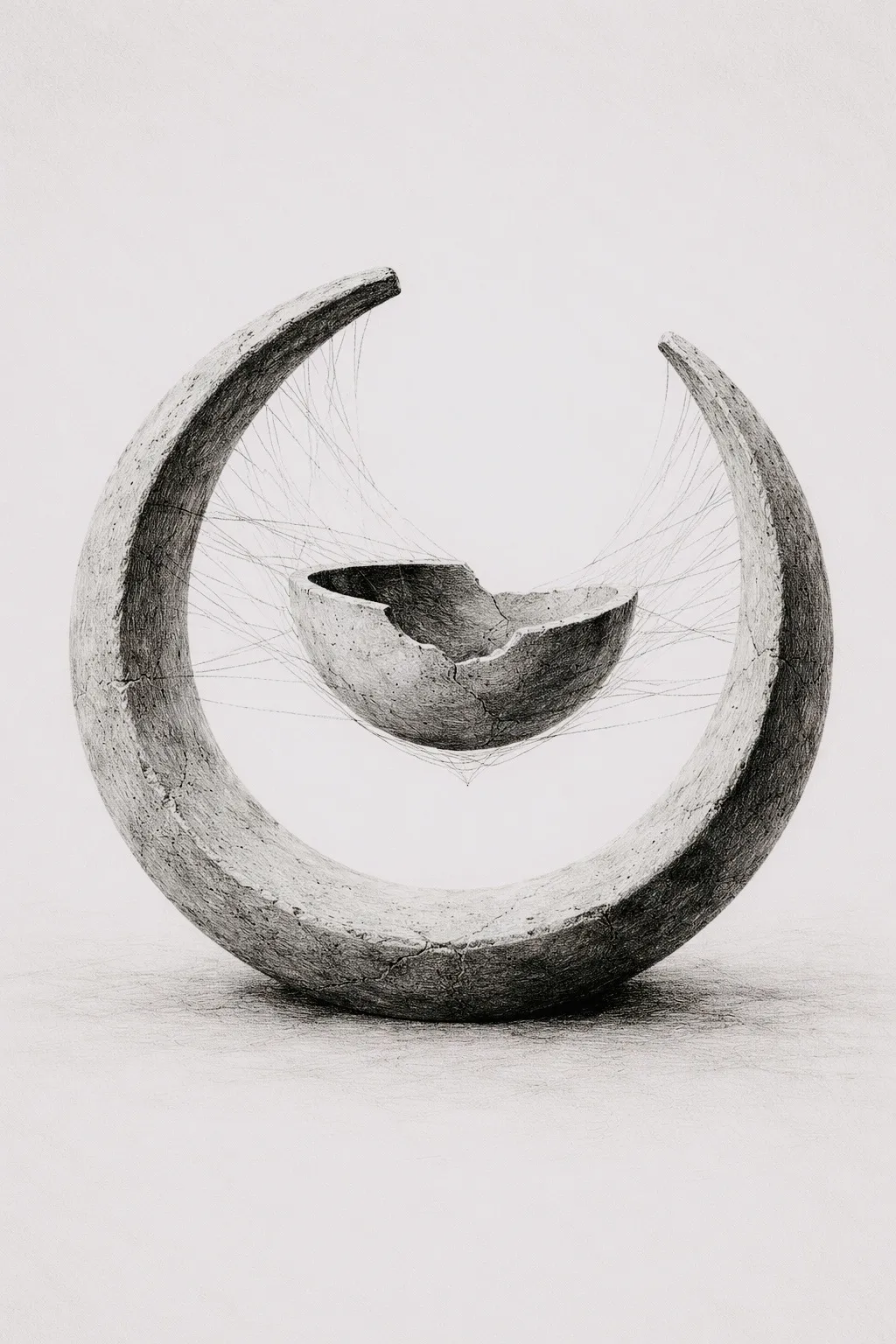
What, then, is being built in care? Not first obedience. Not first confidence. Not first achievement. Not even first virtue in the ordinary sense. What is being built is a container: a structure capable, over time, of receiving reality without immediate collapse, defensive closure, or disorganizing overflow.
That structure does not arise through instruction alone. It is lent, borrowed, repeated, strained, repaired, and slowly sedimented through ordinary acts of life together. Parenting, in this sense, is the repeated construction of a child's capacity to bear reality.
Taken together, these processes do not sit on the same plane, nor do they operate in strict sequence. Borrowed regulation is the movement that runs beneath all of them: the lending of structure where it is not yet owned. But that movement requires conditions. Witnessing provides the perceptual condition—without accurate reception, what follows lands as force rather than form. Repair provides the temporal condition—without return after rupture, disruption hardens into world-structure. Threshold judgment provides the condition of dosage—without calibration, difficulty tips from structuring into corrosive. And atmosphere, shaped by what the adult has been able to metabolize, provides the environmental condition in which all of this either becomes possible or is quietly foreclosed. None of these conditions is dispensable. Together, they constitute what container-building actually requires.
This is why container-building should not be mistaken for the production of calm children, compliant children, or emotionally articulate children in any superficial sense. Its aim is not permanent smoothness. It is the gradual formation of a person who can undergo frustration without immediate fragmentation, survive rupture without assuming the loss of world, and encounter another reality without needing at once to dominate, deny, or flee it. The container, once formed with sufficient strength and flexibility, does not remove difficulty. It changes what difficulty does. It makes possible a life in which contact need not always become flooding, and separateness need not always become threat. In that sense, parenting at its deepest is neither management nor optimization. It is participation in the long formation of a self who may one day be able to remain present to reality without being undone by it.
Parenting, at its deepest, is the slow construction of a form of life within the child: a way of bearing feeling, surviving interruption, receiving reality, and remaining in relation without immediate collapse or defensive conversion.
The ordinary acts of care matter so much because they repeat, accumulate, disappear into routine. Yet it is precisely there, in those countless undistinguished moments of being accurately received, brought back, held within tolerable limits, and formed inside an atmosphere that does not require falsification for contact, that the deepest work is done. What parenting builds, at its best, is not a child who never breaks. It is a person who can come back.
Conclusion
What care builds, then, is the possibility of return. A child who is accurately received, brought back after rupture, accompanied through bearable difficulty, and formed within a field capable of holding rather than distorting inner life gradually acquires something more fundamental than attachment or emotional skill. The child acquires the beginnings of an inner structure to which experience can return without immediate collapse.
That capacity matters not only for psychological survival, but for moral life. For only a self that can return to itself can remain open long enough for another reality to enter without being met at once by defensive closure, retaliatory force, or the need for defensive conversion. The earliest formation of the container is one of the conditions of moral perception itself (Vale 2026, chap. 1). Long before a person can ask whether they truly see another human being, they must first have become the kind of being for whom such seeing does not require immediate defense.
This is why the ordinary afternoon matters. The child with the collapsing blocks. The hand on the back. The adult who does not answer overflow with greater overflow. The parent who can bear enough not to make the child bear the adult's burden first. Nothing grand appears to be happening there. No moral lesson is being announced. No principle is being taught. And yet something decisive may be under construction: the slow formation of a person who, one day, might be able—in three seconds—to see another concrete human being and respond.
That afternoon—the blocks, the hand, the breath borrowed and returned—was not a scene of moral instruction. It was something quieter: one person lending structure to another who could not yet produce it alone. What was borrowed in that moment was not comfort. It was form. And form, repeated often enough, becomes the self's own.
That possibility does not begin in crisis. It begins here. In rhythm, in repair, in accompaniment, in the countless unnoticed acts by which one nervous system lends form to another until form can begin to hold from within. If Chapters 1 and 2 asked what it means to see another person, and what crisis reveals about the threshold of such seeing, then this essay returns to the quieter place where that threshold is first made (Vale 2026, chap. 1–2). The work is ordinary. Its consequences are not.
References
Schore, Allan N. 1994. Affect Regulation and the Origin of the Self: The Neurobiology of Emotional Development. Hillsdale, NJ: Lawrence Erlbaum Associates.
Schore, Allan N. 2012. The Science of the Art of Psychotherapy. New York: W. W. Norton.
Vale, Vulpes. 2026. Seeing This Person: Moral Perception and the Conditions of Its Possibility. Unpublished manuscript.